Trellis is now available for the 2025–26 school year. Request your free 15-minute demo →

Trellis Study

Three fields. Twenty years of research. One convergent answer.

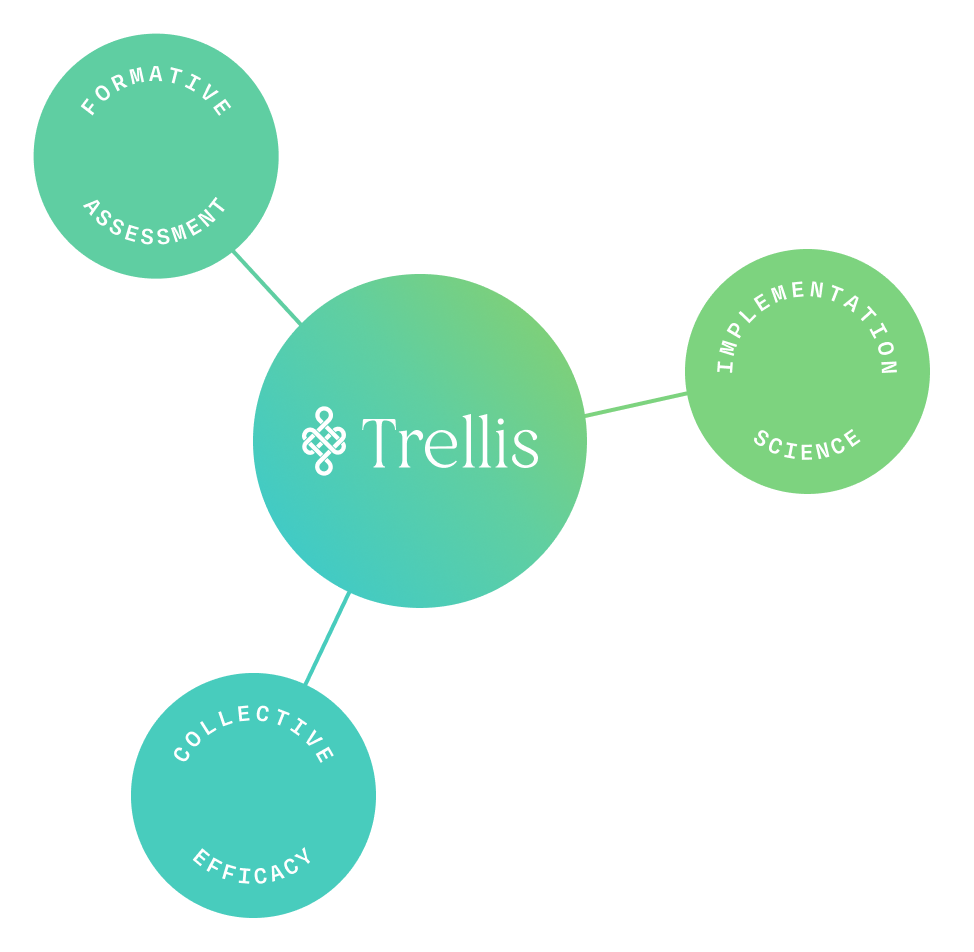
Trellis is built on the convergence of three independent academic research traditions — each studying different aspects of education, each arriving at the same conclusion: the missing ingredient is organizational infrastructure.

Trellis research hero

The Convergence Thesis

Three researchers studied three different problems.
They found the same gap.

All three point to the same structural absence: the lack of a system that makes evidence-based practice automatic, visible, and documented. Trellis is designed to fill exactly that gap.

Study 01

Implementation Science

Dean Fixsen studied why professional development programs fail to change practitioner behavior. He found that training produces knowledge but not practice, and that the missing piece is organizational infrastructure: systems that embed trained behavior into daily workflow.

Study 02

Formative Assessment

Dylan Wiliam studied what makes formative assessment effective. He found that assessment for learning dramatically improves student outcomes, but that it remains "relatively rare" in daily practice because the documentation burden is unsustainable for teachers.

Study 03

Collective Teacher Efficacy

Yaru Zhou synthesized 20 years of research on collective teacher efficacy — identified by John Hattie as the single most powerful predictor of student achievement. She found that despite its enormous importance, "we understand near to nothing about how collective efficacy forms."

The Research Base

See the evidence for yourself

Each researcher summary includes direct quotes, key findings, and how Trellis implements the research.

Study 01
Implementation Science Dean Fixsen

The Problem

Despite advances in evidence-based programs, effective and consistent implementation in classroom settings remains a challenge.

The Findings

0–20% behavior change
from training alone

Training alone appears insufficient for effective implementation; without support, developed competencies rarely translate into consistent practice.

The Trellis Solution

Trellis is the organizational driver that makes training translate.

Read the full summary

Fixsen, D. L., Naoom, S. F., Blase, K. A., Friedman, R. M.,
& Wallace, F. (2005). Implementation research: A synthesis of the literature. FMHI Publication No. 231. NIRN, University of South Florida.

Core Finding

"Training by itself seems to be an ineffective approach to implementation. The 'train and hope' approach does not appear to work."

After reviewing hundreds of experimental studies across health, mental health, education, and social services, Fixsen and colleagues found a consistent pattern: professional development changes what practitioners know, but rarely changes what they do. The gap between knowledge and practice is not closed by better training. It is closed by organizational systems that make trained behavior easier to perform than old behavior.

Why It Matters for MTSS

Districts invest significantly in MTSS competency drivers — selecting staff, providing training, and attempting to scale coaching. What's systematically missing is the organizational driver tier: systems interventions that embed MTSS practice into daily workflow, decision support data that makes implementation visible, and facilitative administration that removes barriers to practice. Without these, training consistently fails to transfer.

Trellis solves this

Trellis is the organizational driver — the systems intervention — that converts MTSS training into daily classroom practice. Intervention trellises surface trained strategies in real time. Timestamped documentation creates decision support data. Admin dashboards give facilitative leadership the visibility to coach and support implementation fidelity.

Study 02
Formative Assessment Dylan Wiliam

The Problem

Although strong evidence shows formative assessment is known to improve learning, teachers often struggle to implement it in everyday classroom practice.

The Findings

2x learning speed with
effective formative assessment

Formative assessment was rarely embedded in everyday classroom practice, even though feedback is one of the most powerful drivers of student achievement.

The Trellis Solution

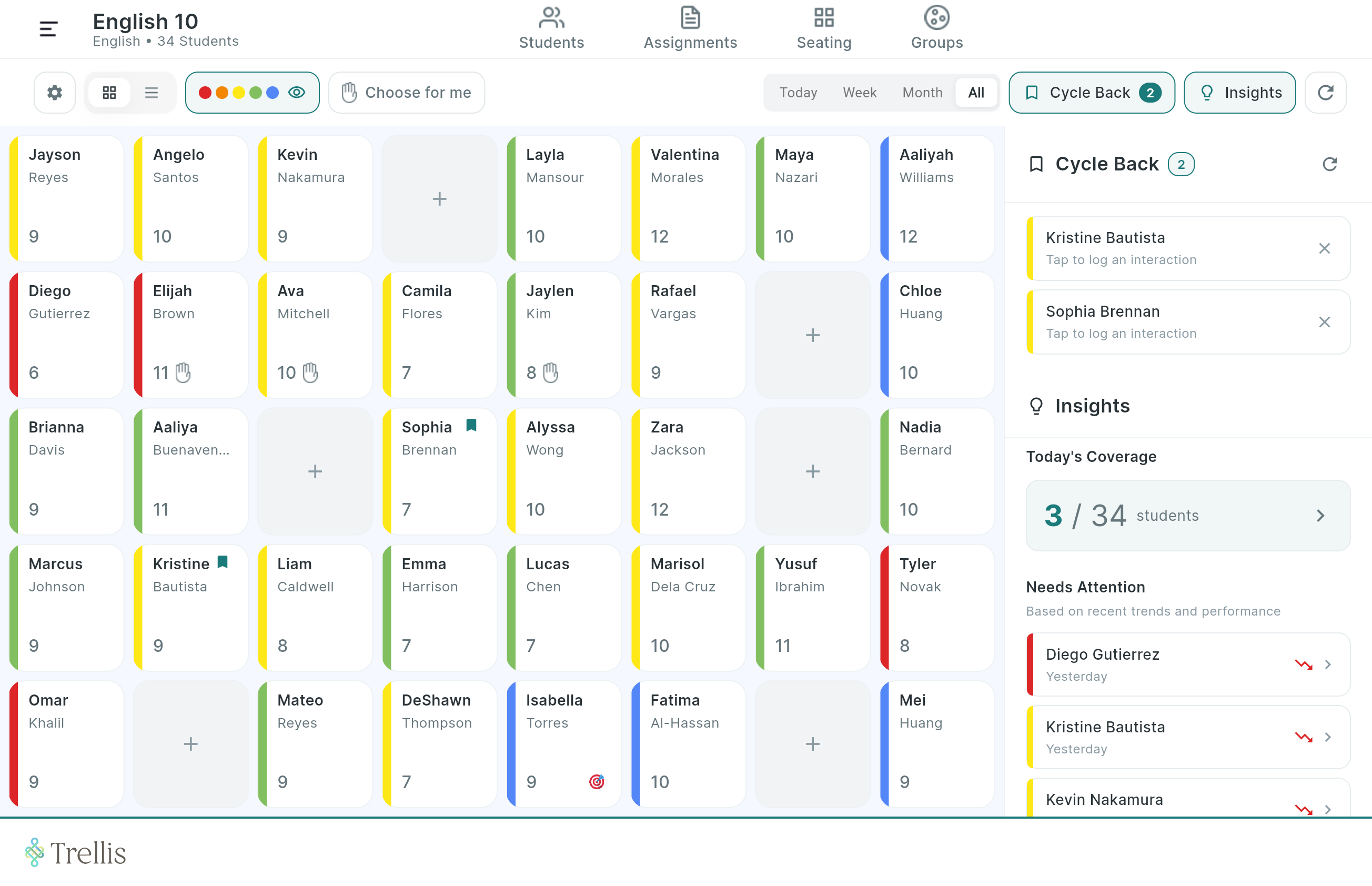
Trellis makes formative assessment effortless. 5 seconds, not 30 minutes.

Read the full summary

Wiliam, D. (2005). Keeping learning on track: Formative assessment and the regulation of learning. Australian Association of Mathematics Teachers, Sydney. Black, P. J., & Wiliam, D. (1998). Inside the black box. Phi Delta Kappan, 80(2), 139–148.

Core Finding

"Since the studies also revealed that day-to-day classroom assessment was relatively rare, we felt that considerable improvements would result from supporting teachers in developing this aspect of their practice."

Black and Wiliam's review of 250 studies found that formative assessment — assessment designed to inform next instructional moves rather than assign grades — dramatically accelerates learning. But it also found that this kind of assessment almost never happens in daily practice. Not because teachers don't believe in it. Because the documentation and reflection burden makes it unsustainable alongside the demands of actual instruction.

The Actionable Feedback Problem

Wiliam distinguishes between feedback and formative assessment: "Feedback is formative only if the information fed back to the learner is used by the learner in improving performance." Most teacher feedback is vague, delayed, or delivered alongside grades, which research shows completely cancels the benefit of any accompanying diagnostic comment. What's needed is specific, in-the-moment feedback tied directly to actionable next steps.

Trellis solves this

Trellis makes day-to-day formative assessment take five seconds. The five-color scale captures nuanced understanding (not binary right/wrong). When a student is marked below standard, the intervention trellis surfaces specific, actionable strategies, not vague feedback. Documentation happens in real time, not from memory at 5:00 PM.

Study 03
Collective Teacher Efficacy Yaru Zhou

The Problem

Evidence-based practices are often poorly defined, making it difficult to understand how they are applied in classroom settings and why outcomes vary.

The Findings

d=1.57 #1 influence on
student achievement

Our understanding of collective efficacy is limited, but evidence shows it is primarily built through mastery experiences, observable proof of effective teaching in practice.

The Trellis Solution

Trellis builds mastery evidence at scale through visible, documented practice.

Read the full summary

Zhou, Y. (2019). Collective teacher efficacy: An introduction to its theoretical constructs, impact, and formation. International Dialogues on Education, 6(2), 69–82. Based on Eells (2011) meta-analysis of 26 studies and Goddard (2001) 47-school study.

Core Finding

"At the Collaborative Impact Conference 2017, John Hattie presented collective teacher efficacy as the 'new number one influence' on student achievement, with an outstanding effect size of d = 1.57."

Zhou synthesizes 20 years of research showing that collective teacher efficacy — the shared belief among faculty that they can collectively impact student learning — is a more powerful predictor of student achievement than any individual teaching practice, socioeconomic factor, or prior achievement. Yet despite its importance, Zhou notes that "we understand near to nothing about how collective efficacy forms at schools."

How Collective Efficacy Actually Forms

Bandura's foundational work identifies four sources of efficacy beliefs: mastery experiences (most powerful, explaining 80% of variance), vicarious experiences (seeing colleagues succeed), social persuasion (being told you can), and affective states (emotional readiness). For collective efficacy to form, schools need infrastructure that creates shared mastery experiences — visible evidence that their collective efforts are working.

Trellis solves this

Trellis creates the mastery experience infrastructure that Zhou identifies as the primary source of collective efficacy. Every documented intervention is evidence of collective capability. PLC dashboards make each teacher's success visible to colleagues. Shared intervention data creates the vicarious learning and social persuasion that build school-wide belief: "We know how to help our students."

The Synthesis

How the three traditions fit together

Research synthesis diagram

Implementation Science

Training fails without
organizational systems

Districts need organization drivers, not just competency training.

Formative Assessment

Formative assessment works,
but is rarely done

Documentation and reflection burden prevents the daily assessment that doubles learning speed.

Collective Efficacy

Collective efficacy is #1, but we
don't know how to build it

Mastery experiences explain 80% of collective efficacy variance.

Trellis — The Convergent Solution

The Trellis infrastructure that makes all three work

Trellis is the organizational driver (Fixsen) that removes the documentation burden (Wiliam) and creates the shared mastery evidence that builds collective efficacy (Zhou). Three problems. One infrastructure. Designed for the classroom, not the compliance office.

Trellis platform screenshot

Primary Sources

Fixsen, D. L., Naoom, S. F., Blase, K. A., Friedman, R. M., & Wallace, F. (2005)

Implementation research: A synthesis of the literature. FMHI Publication No. 231. Tampa: University of South Florida, Louis de la Parte Florida Mental Health Institute, The National Implementation Research Network. Available at: nirn.fpg.unc.edu

Read study

Black, P. J., & Wiliam, D. (1998). Wiliam, D. (2005)

Inside the black box: Raising standards through classroom assessment. Phi Delta Kappan, 80(2), 139–148. Keeping learning on track: Formative assessment and the regulation of learning. 20th biennial meeting of the Australian Association of Mathematics Teachers, Sydney.

Read study

Zhou, Y. (2019)

Collective teacher efficacy: An introduction to its theoretical constructs, impact, and formation. International Dialogues on Education, 6(2), 69–82. Based on Eells, R. J. (2011) meta-analysis of 26 studies; Goddard, R. D. (2001) 47-school study; Bandura, A. (1997) efficacy framework.

Read study

Joyce, B., & Showers, B. (2002)

Student achievement through staff development (3rd ed.). Alexandria, VA: ASCD. Referenced in Fixsen et al., 2005 for coaching effectiveness data: training alone = 0–5%, training + coaching = 90%+.

Read context

See Trellis in action

Change how you think about MTSS documentation.

For Teachers

See exactly what your first class looks like in Trellis. It only takes a few minutes to start using Trellis in your classroom today!

Start for Free

For Administrators

Schedule a 15 minute meeting with our team to learn more and see how quickly we can get your district or school integrated.

Schedule a Demo